
The trade of distress
Norma*, 73, provided the INAD with supporting documents showing more than 4,800 euros in payments for the benefit of “Alicia”, the pseudonym of a woman presenting herself on social networks as a clairvoyant and medium. Behind the promises of “hidden work”, the INAD describes less support than a mechanism of pressure, successive payments and final silence. There are words that serve to enlighten. And others to smoke. In this case, it is a question of “works”, of “blockages” to be removed, of interventions supposed to restore a lost balance. But behind this carefully maintained vocabulary, the file submitted to the National Institute of Divinatory Arts (INAD) tells a much more naked story: that of a 73-year-old woman, sick, fragile, who was sold the idea that salvation was possible, on condition of paying.
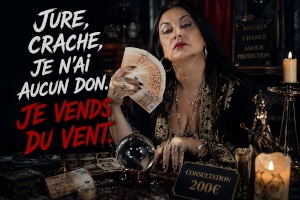
Norma is 73 years old. Retired, suffering from health problems and a difficult personal period, she comes into contact with a woman who, on social networks, presents herself as a clairvoyant, medium and specialist in so-called “occult works”. Promises are those that we address to people who are at their wits’ end: help, a way out, a near outcome. And, very quickly, the promise comes with a price.
The file sent to INAD is not based on a simple story. Norma provided the INAD with a detailed testimony, accompanied by proof of payment showing, according to the elements examined, payments for a total amount of 4,811 euros for the benefit of the company Aveniroscope, Adam B in Morocco and to a company (?) Nextco
According to the information collected, this self-proclaimed clairvoyant, very present on social networks, would have gradually established a relationship of trust with the retiree. To give weight to her speech, she presented herself as capable of acting effectively thanks to particular “works”. She would also have highlighted alleged return trips between France and Morocco, as if the distance, the exoticism or the staging of the trip could be enough to give credence to what was above all an argument of authority.
Then comes the mechanics. First some payments. Then others, more important. Always the same logic: we must continue, settle a new stage, remove an additional obstacle, complete the “work” to the end. With each payment, hope is maintained; with every doubt, a reason to pay again appears.
At the end of the chain, however, there is nothing. No results. No improvement. Not the slightest concrete translation of the promises made.
Only 4,811 euros gone, the savings of an elderly woman, put aside for health expenses, unforeseen events, the ordinary difficulties of a life which, at this age, no longer leaves much room to start again.
When Norma asks for explanations, then reimbursement of the sums paid, the answers become rarer before stopping. Dialogue gives way to silence. A silence which, in this type of case, often says more than all the previous speeches.
Seized of this complaint, the INAD indicates that it examined the documents transmitted, then wrote to Alicia to explain the facts to herdenounced and propose an amicable solution: the reimbursement of 3,840 euros, or 80% of the sums paid, in order to avoid more restrictive procedures. No satisfactory response was given to this letter.
This is where this case ceases to be a simple dispute between a disappointed client and a challenged practitioner. Because what it shows, behind the words “clairvoyance” and “work”, is a more brutal pattern: that of a confidence captured in a vulnerable person, of a hope maintained through promises, then of a series of payments presented as essential until the money runs out, or the victim understands.
It must be said clearly: when the distress of an elderly woman becomes a selling point, when anxiety serves as leverage, when the next transfer is presented as the condition for the promised relief, we are no longer providing support. We are no longer even in the illusion. We are methodically exploiting a weakness.
The suffering of a retiree is not a market. Disease is not a vein. Solitude is not a cash register.
Norma chose to speak out to prevent others from falling into the same trap. His story, supported by the documents submitted to INAD and by an amicable approach that remained unanswered, constitutes a warning. He reminds us that, sheltered from screens, pseudonyms and spectacular promises, some people have less of a taste for mystery than for bank accounts.
Norma now plans to file a complaint with the support of INAD.
Comments collected by INAD–
*name has been changed

Share your point of view in a respectful and constructive spirit.