
legend, manipulation and divinatory heritage
In the history of the great figures of cartomancy, Mademoiselle Lenormand (1772-1843) occupies a special place. Adored by some as the prophetess of the powerful, denounced by others as a skillful manipulator, she remains the most famous icon of clairvoyance under the Empire and beyond. His name, still associated with the Petit Lenormand card game, continues to influence the world of modern tarot reading.
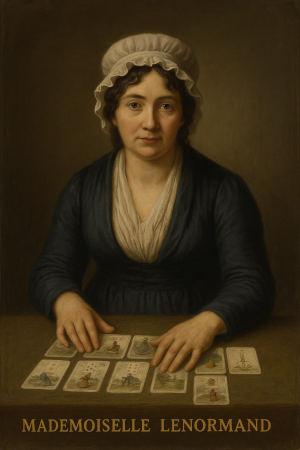
Born in Alençon, orphaned at a very young age, Marie-Anne Adélaïde Lenormand moved to Paris at the age of 14. Initially a linen worker, she learned about divination through cards, stars and palmistry. His Parisian salon quickly became a crossroads for all of revolutionary and then imperial Paris. There she received Joséphine de Beauharnais, generals and even, it is said, Napoleon Bonaparte. If the anecdotes reported in his Memoirs undoubtedly embellish reality, they reveal his keen sense of staging.
A name that has become a brand
Irony of history: the Petit Lenormand, this deck of 36 cards used by thousands of tarot readers today, was not designed by her. It was created after his death by German publishers wishing to exploit his celebrity. However, this name remains an essential reference in contemporary cartomancy. A controversial legacy The National Institute of Divinatory Arts (INAD) highlights the calculating side of the famous sibyl: “Miss Lenormand, a famous fortune teller, knew how to pull all the strings to establish herself as an essential clairvoyant in her time. Her influence was more or less appreciated and mainly served as a means to influence poorly informed people, who took everything she said at face value, often with retroactive effect. A technique used today by self-proclaimed clairvoyants without real divinatory talent. » This criticism highlights a practice that is still current: the art of adapting predictions after the fact to give them prophetic value.
Manipulator or visionary?
Her supporters recall that she embodied a form of female emancipation: an independent woman living from her art in a world dominated by men. Her detractors, on the contrary, emphasize her opportunism: she knew how to flatter egos, handle mystery and publish sulphurous books at the right time to maintain her reputation. Balzac, Hugo and Dumas have all mentioned his name. In popular culture, it remains a symbol of the mystical Paris of the 19th century, a mixture of superstition, social strategy and brilliant communication.
Unlike other more discreet clairvoyants, Miss Lenormand built her fame as much through storytelling as through divinatory talent. A skillful strategist, she knew how to exploit the beliefs and ambitions of her time. But one cannot be “more royalist than the king”: if so many powerful people believed in his predictions, it is also because they sought to believe them.
Her legacy lives on through Petit Lenormand and the myth that she herself created. Between inspiration for tarot readers and warning about human credulity, Miss Lenormand embodies both the power of symbols… and the limits of prophecy.
Youcef SISSAOUI

Share your point of view in a respectful and constructive spirit.